Public demo
A limited, view-only shared sandbox where you can click through a synthetic fleet without installing PiHerder.
| URL | https://piherder-demo.hacknow.info |
| Username | demo@hacknow.info |
| Password | PiHerder@123?_ |
| Role | Shared viewer — same menus as a production read-only user (not admin) |
| Your fleet | This is not your private herder — synthetic data only |
Password may rotate
The shared password is rotated from time to time. This live wiki page always has the current password. If login fails after a rotate, refresh this page (or re-open it from piherder-docs.hacknow.info) rather than relying on an old screenshot, blog post, or cached README.
Login path
- Open https://piherder-demo.hacknow.info.
- Sign in with the shared email/password above (Turnstile may appear on the form).
- Explore the UI — dashboard, hosts, jobs, maps, integrations — under the non-dismissible demo banner.
Some deployments also use Cloudflare Access as an outer email gate before the app login. If you see an Access prompt, complete that step first (project site / invite process), then use the shared demo account.
What to expect
- Full clickable UI with sample hosts, jobs, maps, and integrations
- Banner: shared account · data may reset · some actions simulated
- You cannot onboard real machines, use API tokens, or reach anyone’s home lab
- Job actions succeed as demos only (no live SSH)
- No new accounts — use the shared credentials only
- Password / 2FA on the shared user stay locked (visitors cannot lock each other out)
- Fleet config changes blocked like production viewers; simulated jobs still work for the tour
- Data re-seeds on a schedule (and after operator maintenance) — treat everything as disposable
- Audit client IPs are scrubbed — login and other events still appear, but real visitor addresses are stored/shown as
redacted(column and the details body, including consoleip=…). Seeded lab IPs like10.42.xmay remain. The shared account must not leak other people’s IPs. - OpenAPI is off —
/openapi.json,/docs, and/redocreturn 404 on the public demo (API tokens are disabled anyway). Use your own install for the interactive schema. - Web SSH console is simulated on the public demo — open Console from a host for a toy shell (help / ls / whoami). No live SSH, no network, no real keys. Settings → Console / Security writes 403 (not a multi-tenant shell farm). Your own install uses real Paramiko shells when
PIHERDER_SSH_CONSOLE=true. - Host Files is simulated on the public demo — same chrome as a real explorer, canned tree (no SFTP, no host disk). Shared viewer may browse and open small files / image preview. Upload / delete / zip / privileged are refused. Your own install uses jailed SFTP only when
PIHERDER_HOST_FILES=true(leave that off on the public VPS).
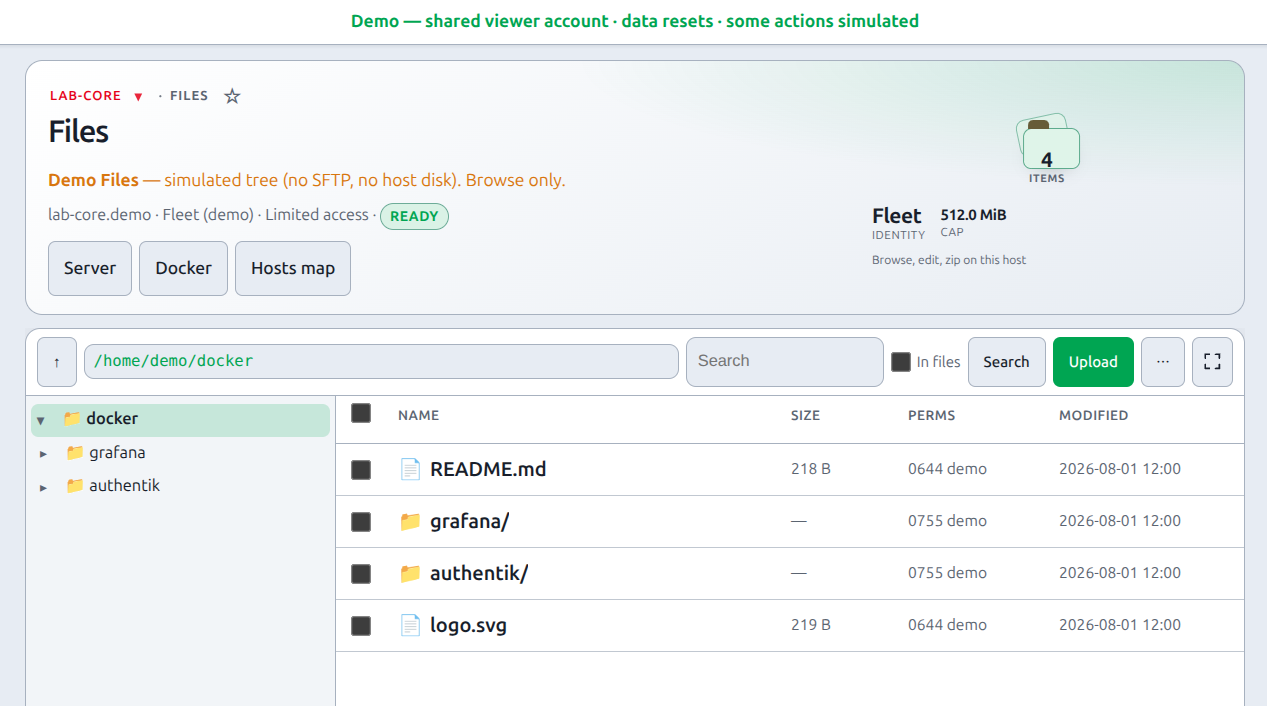
- Service migrate is off — no dest picker, no dataset copy. Host lock / unlock exists on a real install without the migrate flag. Move a service.
Demo screens are not always 100% aligned with a real fleet
Some screens and highlighted features on the demo will not match a real self-hosted implementation pixel-for-pixel. Hosts, inventory, jobs, maps, and integrations are seeded or simulated so the sandbox stays safe and disposable. You may see canned job results, static sample data, or simplified / empty panels where a live deploy would talk to real Pis, Docker, or external services. Treat the demo as a UI tour — your own install against real hosts is the accurate product experience.
What this is not
- Not multi-tenant SaaS for your own fleet
- Not a place to store real config or secrets
- Not an admin sandbox — viewer-only RBAC by design
- Not a guarantee that every panel looks identical to production data
To run your own instance, see Install.
Maintainer ops (VPS, seed, Cloudflare, cron): docs/DEMO_SITE.md in the repo (not required for self-hosting).