Alerts: policy, inbox, webhooks & email
Where: Settings → Alerts (/herder-backups?tab=alerts) — admin only.
Inbox: Alerts in the nav (/notifications) — any logged-in role.
PiHerder surfaces alerts in-app (Notifications) and optional Web Push.
This page covers policy (what fires, how loud) and outbound delivery.
| Channel | Cap ID | Role |
|---|---|---|
| Webhook | Wh-lite | POST JSON to n8n / Signal / Discord / custom |
| SMTP email | H-lite | Alert mail + optional password recovery (G1-lite) |
Env WEBHOOK_* still works as a fallback when Settings has no URL (compose operators).
Alert policy (v1.3)
Settings → Alerts → Alert policy is the taxonomy + volume control so map/discovery noise is not as loud as a cert-fail.
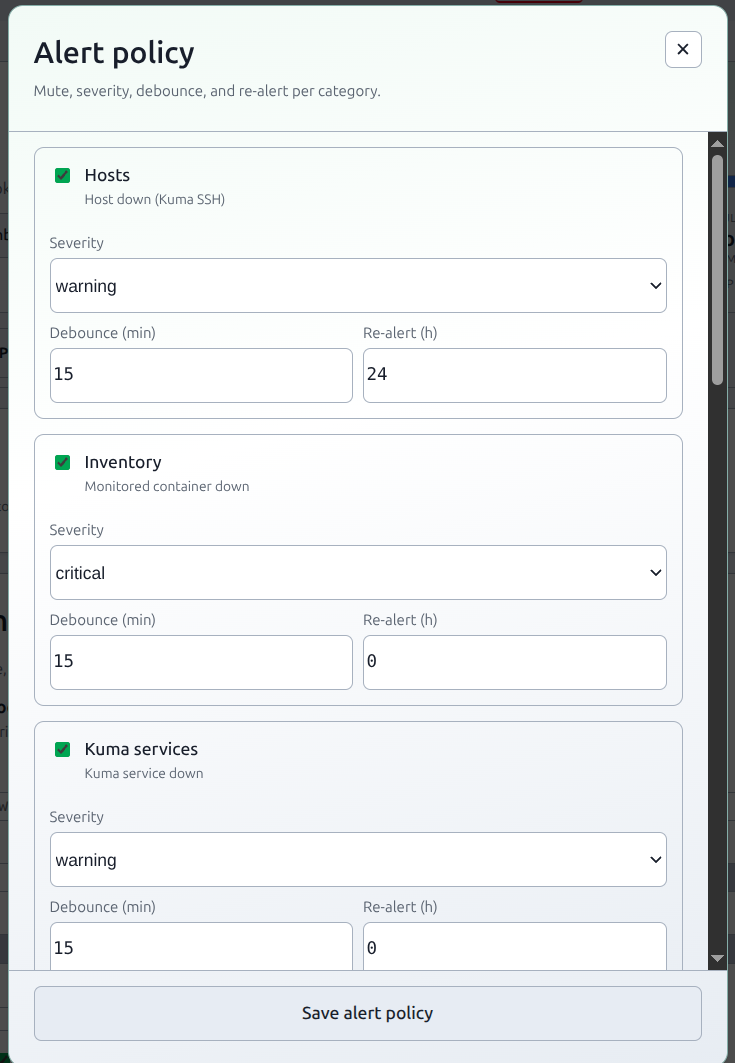
| Category | What fires | Default |
|---|---|---|
| Hosts | host_down — Kuma SSH monitor down | critical · debounce 15m · re-alert 24h |
| Inventory | stack_container_down — Kuma-bound container stopped in Docker inventory | critical · debounce 15m |
| Kuma services | integration_monitor_down — Kuma service monitor down | critical |
| Map infra | map_infra_down — Network gateway / WAN Kuma chip down | warning |
| LAN discovery | nmap_new_device (new host) · nmap_device_offline (stale / not seen ~14d) | warning / info |
| PiHerder stack | stack_health — disk / DB / Redis / Celery | fail = critical, warn = warning |
| Certificates | expiring · renew/deploy/verify failed | warning / critical |
| Backups | host backup failed · herder self-backup failed | critical |
| Updates | OS updates · reboot pending · container image updates | warning |
| Templates | config drift | warning |
Per category you can mute, override severity (default keeps the table above), set debounce (minutes before a dismissed flap re-opens), and re-alert (hours; 0 = no channel nudge while still open).
Severity default means each type keeps its catalog / emitter hint (so stack-health fail vs warn, and cert verify partial vs fail, stay distinct).
Policy is stored in App Settings (herder backup). Demo cannot save it. Changes are audited (alert_policy_changed).
The Network map checkbox Alert when a Kuma-bound container is stopped writes the same Inventory enabled flag (do not fork a second switch).
Host-down
Herder does not ping or SSH-probe hosts for health. Bind an Uptime Kuma SSH / reachability monitor to the host (ssh_reachability). When that monitor goes down, Alerts opens host_down with a Hosts-map focus link.
LAN discovery
- New devices: one inbox row per device (map focus). Webhook / email / push get one digest per scan (“N new devices on LAN”) so a first CIDR scan does not POST 40 times.
- Offline: nmap last-seen older than the stale window (~14 days). Resolve when the device is seen again.
- Mute LAN discovery in Alert policy before the first large scan if you do not want the inbox filled.
- Port add/remove is not an alert.
Debounce and re-alert
Fingerprint upsert still refreshes an open row without re-POSTing. After dismiss, a still-true condition re-opens only after debounce. Re-alert re-fires webhook/email/push on a still-open row after N hours (host-down default 24h).
Alerts inbox
/notifications filters: status, severity, category, type (full catalog), server, page size. Dismiss matching open uses the current filters; Dismiss all open is the whole inbox.
Webhook
- Enable Settings webhook and set URL.
- Optional number / recipients (legacy Signal-style payload).
- Optional shared secret → sent as
Authorization: Bearer …andX-PiHerder-Webhook-Secret. - Choose events: notifications · job summaries · backup scripts.
- Min severity for notification events (
info/warning/critical). - Optional notification categories (subset of the policy table). Empty/all = every category.
- Send test.
Payload shape (stable fields; type / category added in v1.3 for notification events):
{
  "message": "[warning] Title: body",
  "event": "notification",
  "severity": "warning",
  "type": "host_down",
  "category": "host",
  "number": "",
  "recipients": [],
  "link_url": "/dns/physical?focus=n:host-3#map"
}
event is one of notification | job | backup | test.
SMTP
- Enable SMTP · host · port · STARTTLS / SSL / none.
- Username / password (password Fernet-encrypted at rest).
- From email + display name.
- Optional Alert email — recipients + min severity + the same category checkboxes.
- Send test email.
- Optional Allow “Forgot password” on login (requires SMTP ready).
Password recovery (G1-lite)
- Visible on sign-in only when SMTP is enabled, host + from set, and “Allow Forgot password” is on.
- Email always returns a generic success (no account enumeration).
- Token is random, stored hashed, expires in 1 hour, single use.
- Reset revokes trusted devices and bumps session version (other browsers signed out).
- Air-gapped / no SMTP: use admin Users → reset access or logged-in change password.
Related
- Network maps — host-down and gateway/WAN chips
- LAN Discovery — new / offline devices
- Metrics & legacy webhooks
- API tokens
- Settings